Banking Discovery Research
Led the research being conducted on why users (advisors & admin) are not using our banking products and gain their thoughts on potential new banking products.
Overview
LPL Financial is a wealth management firm for independent advisors across the U.S. Their main product is the interface advisors log into. Their secondary interface is what clients log into to.
Role: UX Researcher
Client: LPL Financial
Tools: Figma, Lucid, UserTesting, Powerpoint, Word, Excel
Duration: January 2025 - Now
UXR Methods: Surveys, interviews, SUS (system usabilty scale), competitor analysis, personas, journey maps, & jobs to be done
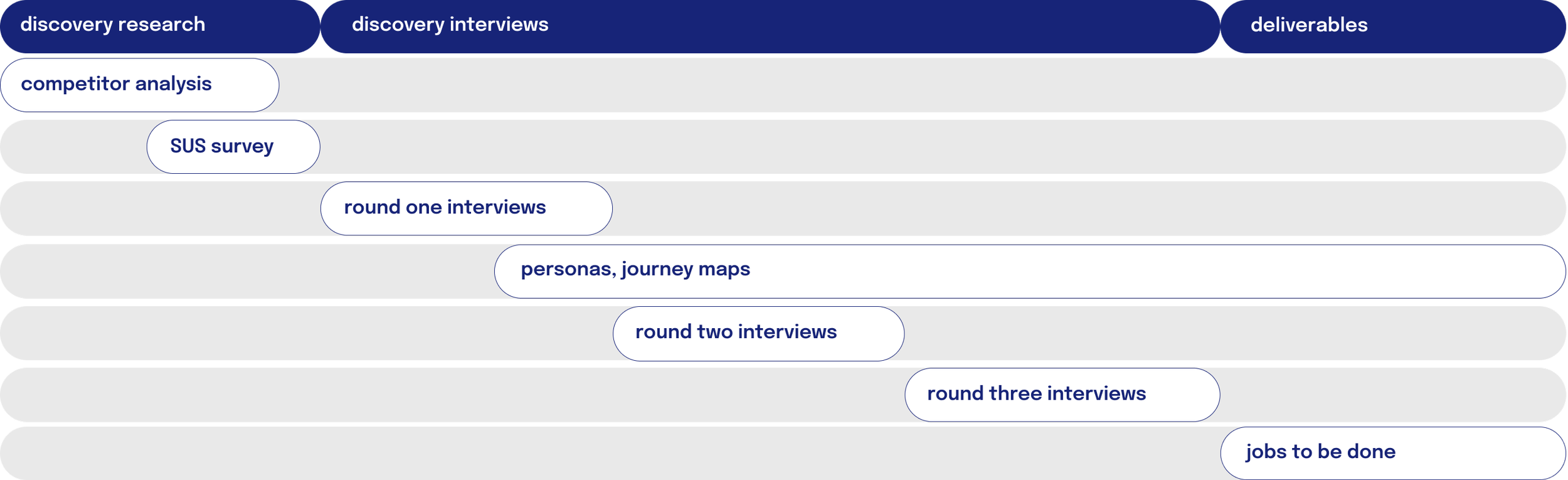
Timeline
Business Goal
In September 2025, LPL relaunched its banking capabilities, including an updated Cash Management Account (CMA). Despite the relaunch, user adoption remained low. UX research was initiated to uncover barriers to adoption and better understand users' needs, expectations, and motivations.
UX Solution
Research revealed three key barriers to adoption: low product awareness, limited understanding of CMA features and benefits, and a desire for more competitive yields. Before reintroducing the product, the focus is on creating a more seamless, intuitive experience that clearly communicates its value, addresses user needs, and encourages adoption.
Discovery Research
Understanding the product
Starting this process I talked to the designers & business to understand how the Cash Management Account (CMA) works and find out what their goals for me were. I first conducted a competitor analysis to understand how our CMA competes with others. Then I sent out a SUS (system usability scale) survey to create a baseline of how well the current interface is working.
Competitor Analysis
Findings
From our findings evaluating other cash management accounts, LPL’s cash management account (CMA) is more than standard in the market. LPL’s CMA has competitive rates, a debit card, unlimited worldwide ATM fee reimbursement, & no fees. It stands out with having a service center for only CMA and creating rates by Household AUM (assets under management). From what LPL is offering compared to the market, we hypothesize this account should be enough for advisors & end investors to use LPL’s CMA. To stand out, be better than the rest, & gain more users LPL is recommended to have real time spending (live updated balances).
Objective
This research examines LPL and other companies’ cash management accounts to see where LPL sits in the market. If LPL is competitive enough for advisors/end investors to use LPL’s products over competitors.
System Usabilty Scale (SUS) Survey
Goals
Benchmark then measure internal user statisfaction with banking usabilty
Pinpoint opportunties for improvement
Identify potential topics for qualitative testing
Findings
Score: 50 F (poor)
There are three main hesitations of adoption: learning resources, interface & expectations
Users had mental models that CMA services were apart of Move Money
Takeaways
Informed future research that there is misunderstandings of what Cash Management services entails, and more clarity on the confusion is needed
When talking to advisors about CMA, we have to be super clear on what it is
Look into what information is being provided for the cash management services/account
Interactions
Lead product & design meetings to understand what the goals were for this test
Conducted the survey and analyzed the results
Presented the results to the banking product team
Discovery Interviews
Round One Interviews
Our first step was to engage directly with users to uncover their perceptions, needs, and expectations of the Cash Management Account (CMA).

Goals
Create personas, journey maps, & jobs to be done out of these interviews
What are users day-to-day experiences with banking at LPL? (including CMA)
How can we improve users’ banking experiences here at LPL?
How is the process of launching a new products for the users?
How can we create & integrate a seamless experience of banking products for our users?
How do we incentivize/gain useres to use our banking products?
How are users’ current experiences with CMA and why are they or why aren’t they using CMA?
Key Insights
I interviewed 6 advisors & 2 admin and from my data analysis found these key insights
Users need stories of use cases to understand the product
Users want more awareness of the product
Users were blindsided when the product was launched
Admin toggle on CMA, just in case the advisor needs it but don’t understand what it is
Users want investments versus banking to be extremly clear and those expectation are set
“If you make the product available without telling the story of how to use it, you’re creating a mess” -Advisor
Actions that were taken & next steps
Marketing created new email campaigns with use cases for advisors from our research
Started early drafts of personas and journey maps
Interactions
Led product/business meetings to draft the research goals
Created and presented the reasearch goals & discussion guide
Made tweaks from product/business feedback
Conducted the interviews
Organized and analyzed the 423 data points
Presented the findings to our products & business partners
Discovery Interviews
Round Two Interviews
Building on insights from the initial research, we conducted a second round of interviews with nine advisors to further explore key findings and deepen our understanding of their needs and perspectives.

Goals
Create personas, journey maps, & jobs to be done out of these interviews
What are users day-to-day experiences with banking at LPL? (including CMA)
How can we improve users’ banking experiences here at LPL?
What do our users’ conversations with end investors about CMA look like?
How is the process of launching a new products for the users?
How do we incentivize/gain useres to use our banking products?
How are users’ current experiences with CMA and why are they or why aren’t they using CMA?
Are users okay with LPL marketing to end investors?
I interviewed 9 advisors and from my data analysis found these key insights
Banking needs to be easy, end investor friendly, seamless, competitive, & convenient
Users want full banking services: some users are okay being the banker and some are not, but they all want to offer banking to end investors.
Users are confused by the naming “Account” in Cash Management Account
Users have no experience with CMA, users don’t understand it, or had only an okay experience with CMA
Users are not pushing CMA because they believe it is too much work, creates a bank expectation, is not compelling/benefical enough, and/or too confusing to explain
Users want to use the products but cannot due to lack of sales tools
Users want clear expectaions of investments versus banking; provide a clear view of how much cash is truly available
Some users are okay with LPL promoting to end investors and some are not
Key Insights
“Give me more tools to solve more problems for people, and I’ll go do it” -Advisor
Actions that were taken & next steps
Identified that the name “Cash Management Account” is unclear to users and this sparked conversations if LPL needs to change the name/term “Account”
This study confirmed banking products prioritization
Advisor/user feedback is being used to understand what advisors are saying and thinking. This research is assisting business in preparing for our annual conference, by using what we are hearing from advisors in preparation for what may be asked
Added more use cases to talk about CMA at the Banking & Lending booth at the annual conference
Continued editing the personas and journey maps
Interactions
Led product/business meetings to draft the research goals
Created and presented the reasearch goals & discussion guide
Made tweaks from product/business feedback
Conducted the interviews
Organized and analyzed the 471 data points
Presented the findings to our products & business partners
Discovery Interviews
Round Three Interviews
Building on insights from the other two phases of research, we conducted a third round of interviews with nine advisors to further explore key findings and deepen our understanding of their needs and perspectives.

Goals
Create personas, journey maps, & jobs to be done out of these interviews
What are users day-to-day experiences with banking at LPL? (including CMA)
How can we improve users’ banking experiences here at LPL?
How can users leverage banking to their advantage?
What is stopping users from using LPL’s banking? What are the barriers?
What do users want to see in the digital banking aspect?
What do our users’ conversations with end investors about CMA look like?
When and why do users use CMA?
What is stopping users from using CMA? What are the barriers?
How do we incentivize/gain useres to use our banking products?
How are users’ current experiences with CMA and why are they or why aren’t they using CMA?
What benefits do users want to see? What benefits would make the user sign up?
I interviewed 9 advisors and from my data analysis found these key insights
Biggest hindrance of CMA is overdraft, not smooth and seamless, move money movements, card security concerns, and learning about CMA at wrong time/not having enough time to learn about CMA
There is a lack of understanding what CMA is & its purpose and therfore users are not confident with CMA/banking due to lack of education, client experience, & setting it up wrong
To get users to recommend CMA/banking, it must be better than what local banks are providing, currently CMA is not competitive in user’s minds
Users would use CMA more if they understood it, had hands on experience, had a higher yield, not a clunky experience, & ease of access
Users don’t have conversations with end investors about CMA, that might change by knowing & understanding its features
Users do have conversations with end investors about CMA when idle cash comes up, cash liquidity, & client not making enough current rate
Between 2%-10% of end investors have CMA enables, not all users have the features turned on because there is not enough use cases to recommend CMA, but users will if it suits the end investors
Key Insights
“I think it’s the knowledge gap, and also just the fear of it, of how it looks” -Advisor
Actions that were taken & next steps
More webinars are needed to understand the product
Wrote out all the jobs to be done
Interactions
Led product/business meetings to draft the research goals
Created and presented the reasearch goals & discussion guide
Made tweaks from product/business feedback
Conducted the interviews
Organized and analyzed the 422 data points
Presented the findings to our products & business partners
Deliverables
Personas, Journey Maps, Jobs To Be Done
From the beginning, we identified personas, journey maps, and Jobs to Be Done (JTBD) as key deliverables to support product and business decision-making. These artifacts were iteratively developed and refined with insights from each round of research, ensuring they reflected evolving user needs and behaviors. We focused on creating banking-specific deliverables to uncover unique pain points, motivations, and opportunities.


Personas
4 personas were created
Advisor who’s not aware and/or doesn’t comprehend Cash Management Account (CMA)
Admin who doesn’t understand Cash Management Account (CMA)
Advisor who knows about Cash Management Account (CMA) but doesn’t use it
Advisor who uses Cash Management Account (CMA)
Journey Maps
4 journey maps were created in conjuction with the personas
Jobs To Be Done
Over 40 jobs were written out
ODI survey is currently being sent out to advisors, pending results at this time
Reflections
Next Steps
Waiting on the results of the Jobs to Be Done ODI survey to see what should be focused on next.
Personal Reflection
Cross-functional partners can delay work moving forward, so it’s important to stay proactive, anticipate next steps, and maintain momentum to ensure we continue uncovering and advocating for users’ needs.